
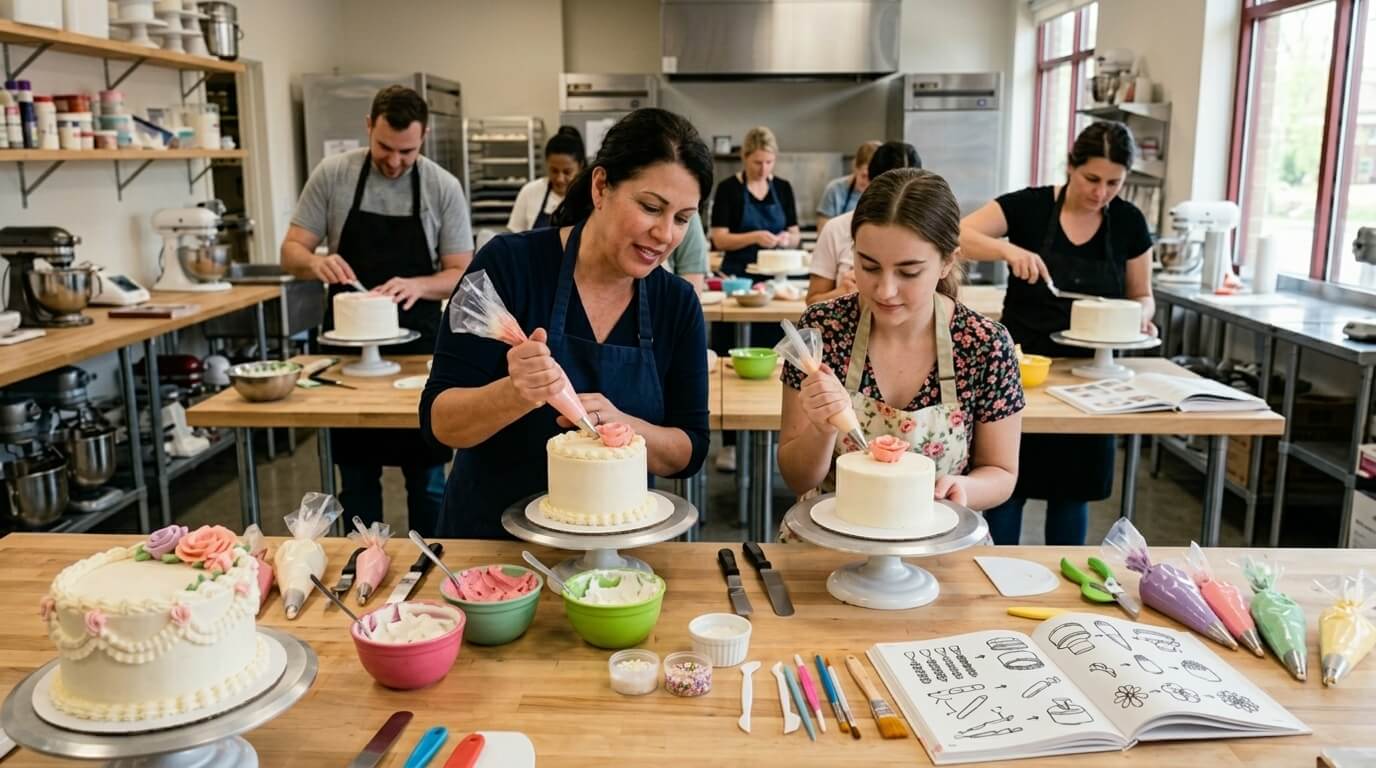

Cake decorating is one of the most creative and rewarding edible arts. Whether you are a complete beginner or looking to advance your skills, this guide covers everything from essential tools to advanced techniques — including chocolate decorating ideas for cakes, edible materials, and how to find the best training.
Cake Decorating Kits for Beginners
Starting with the right tools makes all the difference. The best cake decorating kits for beginners include:
- Piping bags and tips — Both reusable silicone and disposable plastic options; start with a set of 10–20 assorted tips
- Offset spatula — Essential for smooth frosting application
- Bench scraper — Creates perfectly straight sides on layer cakes
- Turntable — Makes smooth frosting dramatically easier; even a basic plastic model helps
- Coupler set — Allows you to change tips without changing piping bags
- Toothpicks and skewers — For making patterns and checking bake completion
Starter kits from brands like Wilton, Ateco, and PME are widely available and provide good quality at a reasonable price.
Chocolate Decorating Ideas for Cakes
Chocolate decorating ideas for cakes range from beginner-friendly to impressive professional techniques:
Chocolate Curls
Chocolate curls for cake decorating are one of the easiest and most elegant techniques. How to make them:
- Use a block of room-temperature chocolate (not refrigerator cold)
- Hold a vegetable peeler at a 45-degree angle against the chocolate block
- Draw the peeler firmly along the side of the block
- Curls will form naturally; chill briefly before placing on the cake
Apply curls to frosted cake using a toothpick or tweezers to avoid melting from hand heat.
Chocolate Ganache Drip
Heat equal parts heavy cream and chocolate, stir until smooth, let cool until slightly thick, then pour over the top of a chilled cake and let it flow naturally over the edges. Simple, dramatic, and professional-looking.
Chocolate Bark Shards
Spread melted chocolate on parchment, sprinkle with dried fruit, nuts, or edible flowers, let set, then break into irregular shards and press into cake frosting for a dramatic effect.
Chocolate Transfer Sheets
Spread tempered chocolate over decorative acetate transfer sheets. Once set, peel away the sheet to reveal a patterned chocolate surface. Cut into shapes for instant professional decorations.
Edible Decorating Materials
Edible Glue for Cake Decorating
Edible glue for cake decorating is used to attach fondant pieces, sugar flowers, and other decorations to cakes and cookies. Commercial edible glue is made from tylose powder and water, or you can make it from dissolved CMC powder. Apply with a small brush.
Edible Paint for Cake Decorating
Edible paint for cake decorating is mixed from gel food coloring and clear alcohol (vodka or Everclear) or lemon extract. It is applied with a fine brush over fondant, isomalt, or chocolate surfaces to create watercolor effects, detailed illustrations, or metallic sheen.
Sugar Paste for Cake Decorating
Sugar paste for cake decorating (also called fondant) is a smooth, pliable sugar dough rolled out to cover cakes or molded into three-dimensional decorations. It creates a smooth surface that can be painted, textured, or embossed.
Edible Pearls and Edible Paper
Edible pearls for cake decorating add elegant texture and sparkle to wedding cakes, birthday cakes, and cupcakes. They are made from sugar and come in various sizes and finishes.
Edible paper for cake decorating — also called wafer paper or rice paper — is printed with food-safe ink and applied directly to the cake surface. It creates photorealistic images, intricate lace patterns, and full cake wraps.
Fresh Flowers for Cake Decorating
Cake decorated with fresh flowers is one of the most popular trends in contemporary cake design. Fresh flower cakes look stunning in photos and are relatively simple to achieve.
Important safety notes:
- Not all flowers are food-safe. Always verify before placing on an edible surface.
- Food-safe flowers include roses, lavender, pansies, marigolds, violets, and chamomile
- Avoid delphiniums, lily of the valley, oleander, and most tropical flowers — these are toxic
- Even food-safe flowers should not be inserted directly into cake — use floral picks or wrap stems in floral tape
- Apply flowers at the last possible moment before serving for freshness
How to Become a Cake Decorator
How to become a cake decorator is a path that combines culinary training, artistic skill, and business knowledge:
- Learn fundamentals — Take cake decorating lessons near me or cake decorating lessons online free through platforms like Craftsy, Skillshare, or the Wilton Method
- Practice consistently — Decorate a cake at least once a week to build speed and precision
- Specialize — Choose your focus: wedding cakes, novelty cakes, sculpted cakes, or sugar flowers
- Build a portfolio — Document every cake with professional photos. Your portfolio is your most important business tool
- Get certified — Wilton, the PME Diploma, and local culinary school certificates add professional credibility
- Start taking orders — Begin with friends and family, then move to platforms like Instagram and local vendor markets
Where to Learn Cake Decorating
Cake decorating lessons near me can be found at:
- Local bakeries and cake studios offering workshops
- Community college culinary programs
- Craft stores like Michaels (Wilton Baking Classes)
- Independent cake decorating schools
Cake decorating lessons online free are available through:
- YouTube — countless detailed tutorials for every technique
- Craftsy — some free classes with premium upgrades available
- Wilton.com — free basic tutorials and technique videos
Key Takeaways
- Cake decorating kits for beginners should include piping tips, offset spatula, bench scraper, and turntable
- Chocolate curls and ganache drips are the easiest professional-looking chocolate techniques
- Always verify flowers are food-safe before using as cake decoration
- Edible paint, pearls, and paper expand your decorating repertoire significantly
FAQs
What tools do I need to start cake decorating?
A turntable, offset spatula, bench scraper, piping bags, and a basic set of piping tips from a cake decorating kit for beginners give you everything you need to get started.
Are fresh flowers safe on cakes?
Some are, some are not. Always research the specific flower before using. Food-safe flowers include roses, pansies, lavender, and violets. Never use pesticide-treated flowers on food.
Can I learn cake decorating online for free?
Yes. Cake decorating lessons online free are available on YouTube, Craftsy, and Wilton’s website. They cover everything from basic buttercream to advanced fondant work.